

A Complete Guide to Choosing the Best HVAC System for Your Home
Selecting the right heating and cooling system for your house is very important. It will impact how comfortable...

Living in Panama City or along the Emerald Coast lets you enjoy serene views daily, but it comes with certain drawbacks too. These can include musty smells, dust on every shelf, allergies that flare up all season due to Florida’s humidity.
Locals therefore are now turning to REME HALO technology to clean their home’s air. The technology spreads reactive cleaning agents into the air of your house through a cooling and heating system, to cut volatile organic compounds (VOCs).
So how well does it work? We’ll look at what the testing shows and where it falls short.
Quick Summary
REME HALO, an in-duct air purification technology that utilizes low levels of hydrogen peroxide, to reduce certain airborne contaminants and musty odors. It’s usually fitted inside the central air conditioning system of a house instead of a whole new system installation. However, its efficiency depends on different factors like model, installation, airflow and indoor conditions.
Want Better Air Inside Your Home?
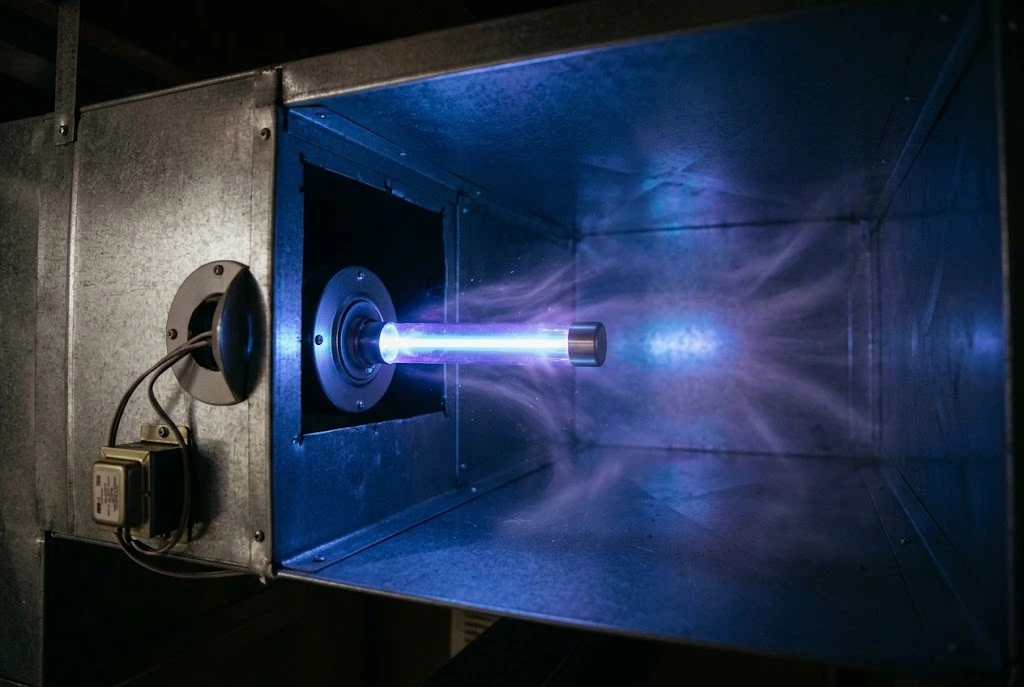
Call UsIt is RGF Environmental Group’s manufactured in-duct air purification system; a portable purifier to clean the air of one room. This one hooks up to your main air conditioning system and blows its cleaning agents through the ducts, so the whole house gets treated.
It uses a combination of ultraviolet (UV) technology and a catalyst to create reactive compounds, including a small amount of airborne hydrogen peroxide. These compounds are designed to react with certain pollutants, odors and microorganisms as treated air moves through your home.
Treat it as an extra layer, handy when odors won’t leave or you’re concerned about certain biological contaminants. It won’t stand in for a properly sized HVAC filter, regular maintenance, or moisture control.
RGF itself calls the process an advanced oxidation process. In plain terms, UV light and a catalyst team up to make reactive cleaning compounds. Here’s how the main parts work.
The UV source reacts with the system’s catalyst and with moisture that’s already in the air. That reaction produces reactive compounds, including hydrogen peroxide in low concentrations.
The generated compounds travel through the system ductwork with the moving air. They are intended to interact with certain pollutants in the air and on exposed surfaces.
Some REME HALO models and related versions incorporate bipolar ionization. This process produces charged particles that can cause smaller airborne particles to cluster together. Larger particles may then be easier for the HVAC filter to capture.
Because the equipment is installed inside the main system, its output moves through the ductwork when the blower operates. This gives it a whole-home application rather than limiting treatment to one room.
RGF publishes laboratory and controlled-test results to demonstrate the performance of its air purification technology. These results are useful when evaluating the product, but they need to be read in context.
Some commonly referenced findings include:
These figures do not mean that every home will experience the same percentage reduction. Laboratory chambers have controlled conditions that differ from occupied homes, where room size, air movement, HVAC runtime, contaminant sources, and maintenance all affect performance.
Manufacturer testing tells only part of the story. Homeowner discussions can reveal questions that may not appear in product brochures.
Two discussions in the r/hvacadvice community offer useful examples.
In one REME HALO installation discussion, a homeowner reported an unpleasant smell when the HVAC fan started after the original REME HALO was installed. The discussion raised questions about ozone, fan operation, wiring, and possible gaps around the installation opening.
Another discussion about a REME HALO UV system reflects the mixed experiences and questions homeowners have about these systems, including whether the equipment delivers noticeable benefits and what to expect after installation.
These conversations are anecdotal. They do not prove that the product works or fails. However, they highlight several practical points:
People pay soecifc considerations about the Ozone when choosing an electronic air-cleaning device. At ground level, ozone can irritate the respiratory system, so homeowners should understand the differences between product models.
The original REME HALO and newer versions should not automatically be treated as identical when discussing ozone emissions.
REME HALO: The original model uses a UV lamp and catalytic technology. Check the specifications and certification information for the exact model being offered rather than assuming it has zero-ozone verification.
REME HALO Zero: RGF describes this version as verified Zero Ozone to the UL 2998 standard. Its product specification lists a recommended cell replacement after two years.
HALO-LED: This model uses LED-based technology instead of a conventional mercury-containing UV lamp. RGF describes it as mercury-free and zero-ozone compliant, with a longer cell replacement interval. Its current specifications list approximately five years, although the applicable model documentation should always be checked.
The EPA recommends choosing bipolar ionization devices that meet UL 2998 when homeowners decide to use this type of technology. UL 2998 is an environmental claim validation procedure for zero ozone emissions.
CARB certification is another term worth understanding. The California Air Resources Board maintains a list of certified air-cleaning devices and evaluates compliance with ozone-emission requirements. However, CARB certification does not establish how effectively a device removes pollutants or prove that it provides a health benefit.
REME HALO is installed inside the air circulation system’s ductwork, generally near the air handler. RGF recommends the supply plenum just after the air handler when the system allows it. The return side may also be an option when supply-side installation is not practical.
Several factors can affect how the equipment operates:
Professional installation helps ensure the equipment is mounted, powered, and configured according to the manufacturer’s instructions. It also gives the technician an opportunity to check whether the air-quality concern is coming from another part of the system.
REME HALO requires periodic cell replacement to maintain its intended output.
RGF recommends replacing the original REME HALO cell after approximately two years or up to 25,000 hours of operation. The REME HALO Zero specification also lists a two-year replacement recommendation.
HALO-LED has a longer service interval. Its current product information lists approximately five years, although the exact replacement schedule should be confirmed using the documentation for the installed generation.
Replacement timing matters because the output of the purification cell decreases as it ages. Waiting until a component stops working completely may leave the homeowner with a system that is no longer operating as intended.
REME HALO technology could be worth a look if you want one more air-treatment option tied into your central air cooling and heating system.
It may fit if your household deals with:
If you live on the Emerald Coast, pay extra attention to humidity. Warm, wet air can lead to condensation and damp spots when ventilation, drainage, or the A/C isn’t doing its job.
Air cleaners don’t all work the same way; which one fits depends on what you’re trying to remove and what’s going on inside your home.
| Feature | REME HALO | UV Light Only | Portable HEPA Purifier |
| Installation | Inside HVAC ductwork | Inside HVAC system | Individual room |
| Main approach | Active air treatment | UV exposure | Physical filtration |
| Odors and VOCs | Designed to reduce certain odors and VOCs | Limited effect on gases and odors | Requires suitable gas-phase media |
| Particle capture | May help particles become easier to filter | Not its primary function | Captures particles as air passes through |
| Coverage | HVAC-connected spaces | HVAC-connected spaces | Room where placed |
| Ozone considerations | Depends on the exact model | Depends on equipment design | Mechanical HEPA filtration does not require ozone generation |
Not Sure Which Air Purifier to Choose? Let us help you find the right option.
Call UsIt is an add-on, not a replacement for anything. Your HVAC filter still does the job of catching dust and pollen, and a purifier can’t fix a leaking duct, a clogged condensate drain, or high indoor humidity. Those problems need their own repair. Results also vary from home to home, since lab testing doesn’t match a house with pets, cooking, and open doors.
It isn’t an allergy or asthma treatment either, so check with a doctor for breathing concerns. And expect some upkeep, since replacement cells and regular HVAC maintenance add to the cost.
If you’ve made up your mind to buy an in-duct air purifier, follow an effective checklist first.
The purity of your home’s indoor air relies on the working condition and maintenance of its air conditioning system. As a neighbouring company, Arctic Air & Refrigeration provides services across the Panama City with all of it. You can get all the services suitable to your home including:
Thinking about REME HALO or another purifier? Start by finding out what’s affecting the air in your home. We can talk through the right indoor air quality upgrades for your HVAC system.
It’s basic function is to reduce airborne contaminants, faul smells, and VOCs; although the published testing supports it under controlled conditions, but real, lived-in homes can give different results.
It uses UV and a catalyst to create reactive compounds, including a small amount of hydrogen peroxide. These compounds are designed to react with VOCs and odor-causing compounds.
That varies from model to model. RGF makes zero-ozone claims specifically for the REME HALO Zero and HALO-LED. Don’t assume all versions have the same certification, ask for documents on the exact unit.
RGF recommends replacing the original REME HALO cell every two years or so; HALO-LED has a longer life, with a replacement period stated at about five years.
It could be, if you want an in-duct air-treatment system and you’re clear on what it can’t do.
REME HALO Zero is a separate version with RGF’s UL 2998 Zero Ozone verification. Don’t assume the original REME HALO has the same certification.
It’s meant to treat certain airborne contaminants, but it isn’t a proven allergy treatment. For pet dander and other particles, good HVAC filtration and a properly sized HEPA purifier are better bets.
It depends on the model and its wiring. HALO-LED is designed to operate with the blower and must be wired according to RGF’s instructions.
REME HALO technology offers another option for homeowners who want to address certain indoor air quality concerns through their central HVAC system. It is especially important to identify the source of an air quality problem for homes in Panama City Beach and across the Emerald Coast. Arctic Air & Refrigeration can assess your HVAC system and discuss indoor air quality options for your home. Call (850) 276-0744 to talk with our team about improving the air quality in your home.


